

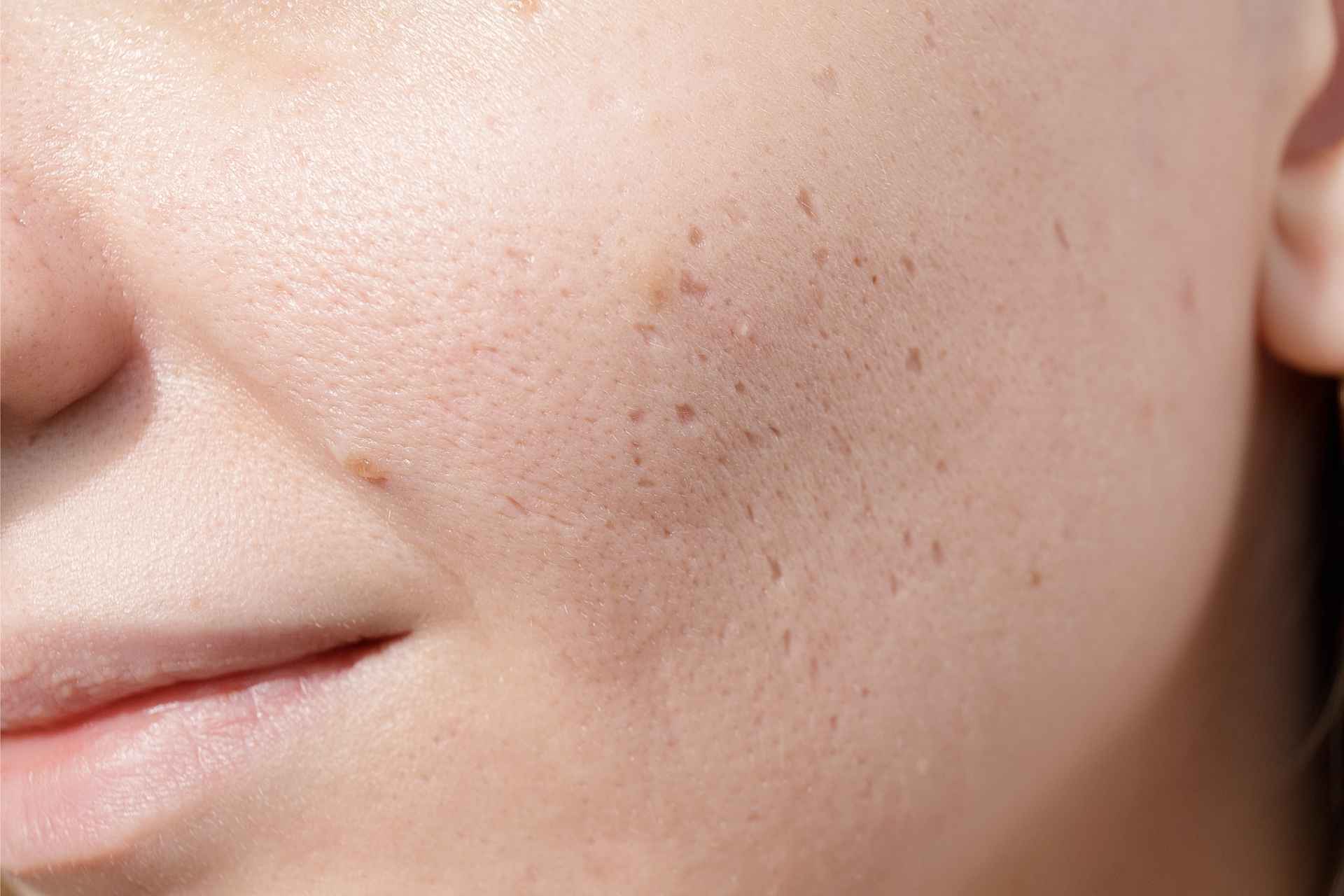
Smoother scars without a week of downtime
Fractional picosecond laser smooths acne scars by renewing the skin from within. The skin’s surface stays almost intact, so most people return to work and everyday life the very next day. Studies show picosecond lasers smooth pitted scars nearly as effectively as CO2 lasers, but with clearly less pain, faster healing, and a lower risk of pigment changes.
At Ihosairaala we use both picosecond and CO2 lasers. That means we can choose the treatment that best suits your scars and your situation – or combine both.
Book a free nurse consultation >
Picosecond laser at a glance
| Suitable for | Shallow to moderately deep pitted scars, uneven skin texture, also darker skin tones |
|---|---|
| Number of sessions | Typically 3–6, roughly 4–8 weeks apart |
| Session length | About 20 minutes plus numbing |
| Pain | Mild – our patients typically rate it around 1/10 |
| Recovery | Redness and swelling for about 1–2 days |
| Results | Develop gradually; final result visible about 3–6 months after the last session |
What does the picosecond laser do to the skin?
The picosecond laser is named after its pulse length: a single pulse lasts picoseconds – trillionths of a second. A pulse this short barely heats the skin at all. Instead, the energy releases instantly as a tiny pressure wave.
In fractional treatment, the laser beam is split by a special tip into hundreds of tiny points. At each point, a microscopic cavity forms inside the skin. The skin repairs these spots while also producing new collagen and elastin. Over the following months, the base of the scars rises and the skin’s surface becomes smoother.
The skin’s surface layer stays almost intact during treatment. This is the picosecond laser’s biggest difference from the CO2 laser, and it explains the short recovery time.
Picosecond laser or CO2 laser?
Both lasers smooth acne scars on the same principle: they create a dense grid of tiny treatment points in the skin, and as these heal, the skin renews itself. The difference lies in how those treatment points are created.
| Fractional picosecond laser | Fractional CO2 laser | |
|---|---|---|
| How it works | Short pulse, pressure wave inside the skin | Heat vaporizes narrow channels from the surface down |
| Skin surface | Stays almost intact | Opens at small points |
| Pain | Mild | Moderate, numbing needed |
| Recovery | 1–2 days | About a week, with lingering mild redness |
| Risk of pigment changes | Low | Higher, especially on darker skin |
| Efficacy | Nearly the same as CO2 laser | Slightly better overall result, especially for deep scars |
| Number of sessions | 3–6 | 3–5 |
What does the research show?
Picosecond and CO2 lasers have been compared in randomized split-face studies, where one half of the face is treated with one laser and the other half with the other.
- In a Thai study of 25 patients, the picosecond laser smoothed scars just as well as the CO2 laser. Pigment changes occurred on the CO2 side in 24% of patients, and in none on the picosecond side. (Sirithanabadeekul et al. 2021)
- In a Chinese study, there was no difference in scar scoring, but physicians and patients rated the overall result on the CO2 side slightly better. The picosecond side had clearly fewer side effects. (Yuan et al. 2025)
- In another comparison against an ablative laser, scars improved by 39% with the picosecond laser and 44% with the ablative laser. The picosecond laser was less painful (2.1 vs. 3.5 out of 10), and scabbing lasted about half a day on average instead of two days. (Dai et al. 2023)
- In a pooled analysis of seven studies, the picosecond laser was as effective as other fractional lasers, but with less pain and fewer pigment changes. (Li et al. 2023)
In summary: The picosecond laser is a good choice when you want results without extended downtime, or if your skin tends to develop pigment changes. If the goal is the greatest possible improvement in deep scars and you can take a week of downtime, the CO2 laser may be a better fit. Often the best results come from combining treatments.
Who is the picosecond laser suitable for?
The picosecond laser is especially suitable if
- you have shallow to moderately deep pitted scars (boxcar and rolling scars)
- you can’t or don’t want to take a week of downtime
- your skin is darker or prone to pigment changes
- alongside scars, you also have redness, enlarged pores, or uneven skin tone
- you are on isotretinoin and want to start scar treatment already during the course
The picosecond laser alone isn’t enough if
- you have very deep, narrow ice-pick scars – these may need to be combined with other treatments
- your scars are strongly tethered down by fibrous bands
- your scars are raised or keloid – these are treated with cortisone injections and cryotherapy
In these cases, the picosecond laser is often used after other treatments to refine the surface.
When should treatment be postponed?
- Active inflammation or cold sores in the treatment area
- Recently tanned skin
- Pregnancy
If you’re prone to cold sores, your doctor can prescribe preventive medication for the treatment period.
Can picosecond laser treatment start during an isotretinoin course?
Usually, yes. In the past, it was recommended to wait 6–12 months after finishing isotretinoin before treating scars, but current evidence suggests this waiting period isn’t necessary. In a randomized study, picosecond laser treatment during an isotretinoin course improved scars significantly compared with the untreated side, with no lasting side effects. (Xue et al. 2023) Acne scars respond better to treatment the earlier it’s started.
How does the treatment proceed?
Before treatment
- Avoid sun tanning and self-tanning products for about 4 weeks before treatment.
- Tell your doctor about any medications or creams you’re using.
- Come to the appointment without makeup, if possible.
The treatment visit
- The skin is cleansed and a numbing cream is applied.
- Your eyes are protected.
- The laser is passed systematically over the treatment area. It feels like quick snapping or tingling. Our patients typically rate the pain around 1/10.
- The skin is cooled afterward.
After treatment
- The skin is red and warm, somewhat like a mild sunburn. The redness usually fades within 1–2 days.
- Tiny pinpoint bruises may appear on the skin and disappear within a few days.
- You can usually apply makeup the next day.
- Use a moisturizer and SPF 50 sunscreen daily. Sun protection is the single most important factor in preventing pigment changes.
- Avoid saunas, swimming, and strenuous exercise for 1–2 days.
- Pause retinoid creams and acid peels for a few days.
Treatment course: Treatments are typically given 3–6 times, about 4 weeks apart. The skin continues renewing itself for months after the last session, so the final result becomes visible after about 3–6 months.
What can you expect from picosecond laser treatment?
- Scars become shallower but rarely disappear completely. Studies show pitted scars improve by an average of about 50% after a course of treatment.
- Change happens gradually. Many people notice smoother skin texture and improved glow after just a few sessions, but the scars themselves take months to shallow out.
- The result is permanent. The new collagen remains in the skin. Aging and new acne can, however, change the skin later on.
- Deep scars often need additional treatments. Because of this, a treatment plan may include other methods as well.
Possible side effects are usually mild and temporary: redness, swelling, pinpoint bruising, and rarely, temporary darkening. Permanent side effects are very rare.
Picosecond laser as part of combination treatment
The picosecond laser works well alongside other acne scar treatments:
- Subcision + picosecond laser: subcision releases rolling scars from beneath the skin, and the picosecond laser smooths the surface.
- TCA CROSS or punch excision + picosecond laser: deep, narrow scars are treated locally first, and the picosecond laser finishes the surface.
- Tience + picosecond laser: this injectable treatment supports collagen formation between laser sessions.
- AdvaTx + picosecond laser: AdvaTx reduces redness left by acne, while the picosecond laser smooths the scars.
Why choose Ihosairaala?
- Both picosecond and CO2 lasers available. Treatment is chosen based on your scars and preferences – not on whichever device happens to be at the clinic.
- A center specialized in acne scar treatment. We offer all modern treatment methods: three different lasers, punch excisions, subcision, TCA CROSS, dermal fillers, and Tience injections.
- Acne and scar treatment in one place. Scar treatment can begin already during acne medication.
- Two locations in central Helsinki: Kamppi and Eteläranta, with evening appointments available on weekdays.
Book a free nurse consultation >
Frequently asked questions
Does picosecond laser treatment hurt?
Not much. The skin is numbed with a cream, and our patients typically rate the sensation around 1/10. Studies show the picosecond laser is, on average, clearly less painful than other scar lasers.
How soon can I go back to work?
Most people return to work the next day. Redness usually fades within 1–2 days, and makeup can be applied the following day.
How many sessions do I need?
Typically 3–6. Your doctor will estimate the number during the consultation based on the depth and type of your scars.
When will I see results?
The skin’s surface can smooth out after just a few sessions, but collagen forms slowly. The final result appears about 3–6 months after the last treatment.
Is the picosecond laser as effective as the CO2 laser?
Nearly. Comparative studies show similar improvement in scar depth, but the CO2 laser has produced a slightly better overall result. The picosecond laser’s advantages are shorter recovery, less pain, and a lower risk of pigment changes.
Is it suitable for darker skin?
Yes. Because the picosecond laser barely heats the skin, the risk of pigment changes is lower than with heat-based lasers. This is one of its key advantages.
Can I get treatment during an isotretinoin course?
Usually, yes. Research shows picosecond laser treatment is safe and effective even during the course, and scars respond better to treatment the earlier it’s started.
What time of year is best for treatment?
Picosecond laser treatment can be done year-round, as long as the skin isn’t freshly tanned and you remember daily sun protection. Autumn and winter are the easiest seasons.
Are the results permanent?
The new collagen remains in the skin, so the improvement is permanent. Active acne can, however, create new scars, so it’s worth keeping acne under control too.
Sources
-
- Sirithanabadeekul P, Tantrapornpong P, Rattakul B, Sutthipisal N, Thanasarnaksorn W. Comparison of Fractional Picosecond 1064-nm Laser and Fractional Carbon Dioxide Laser for Treating Atrophic Acne Scars: A Randomized Split-Face Trial. Dermatol Surg 2021;47(2):e58–e65. doi:10.1097/DSS.0000000000002572
- Yuan Y, He Y, Fang J, Zhang M, Wu Q. Comparison of the fractionated Nd:YAG 1064-nm picosecond laser with holographic optics and the fractional CO2 laser in atrophic acne scar treatment: a prospective, randomized, split-face study. Int J Dermatol 2025;64(1):85–91. doi:10.1111/ijd.17296
- Dai R, Cao Y, Su Y, Cai S. Comparison of 1064-nm Nd:YAG picosecond laser using fractional micro-lens array vs. ablative fractional 2940-nm Er:YAG laser for the treatment of atrophic acne scar in Asians: a 20-week prospective, randomized, split-face, controlled pilot study. Front Med (Lausanne) 2023;10:1248831.
- Li J, Duan F, Kuang J. Fractional picosecond laser for atrophic acne scars: A meta-analysis. J Cosmet Dermatol 2023;22:2205–2217. doi:10.1111/jocd.15862
- Xue H, Ye D, Huang SL, et al. Early acne scar intervention with 1064 nm picosecond laser in patients receiving oral isotretinoin: a randomized split-face controlled pilot study. Lasers Med Sci 2023;38:40. doi:10.1007/s10103-022-03702-0
- Brauer JA, et al. Use of a Picosecond Pulse Duration Laser With Specialized Optic for Treatment of Facial Acne Scarring. JAMA Dermatol 2015;151:278–284.
Reviewed by: Carl Kyrklund, MD, PhD, Specialist in Dermatology
Picosecond laser for acne scars – pricing
| Picolaser | Price (VAT 0%, incl. outpatient clinic and Kanta fee) |
|---|---|
| Picolaser for acne scars, cheeks | 708,86 € |
| Picolaser for acne scars, cheeks+temples or chin | 807,44 € |
| Picolaser for acne scars, face | 834,67 € |
| Picolaser for acne scars, cheeks x3 | 1 672,58 € |
| Picolaser for acne scars, cheeks+temples or chin x3 | 1 909,17 € |
| Picolaser for acne scars, face x3 | 1 974,52 € |